Give carbon removal its own ledger
Align the rules with international practice, and the money stays in Taiwan.
In September 2026, Taiwan's Minister of Environment, Peng Chi-ming, announced that Taiwan would reach one million tonnes of biochar carbon removal by 2030. If your boss, a colleague or a reader has recently asked you "What is carbon removal, and what does it have to do with us?", this page explains it in five minutes.
The short answer: carbon removal needs a ledger of its own, kept according to international rules. That choice will decide whether the money companies spend on carbon removal stays in Taiwan or flows abroad.
What is carbon removal, and how is it different from cutting emissions?
Think of emitting carbon as using a credit card. Cutting emissions means spending less. Carbon removal means paying off the balance: taking carbon that is already in the air back out and storing it for the long term.
Biochar is one way to do this. Crop and forestry residues such as rice straw and branches are heated with little oxygen and turned into charcoal. Carbon that would otherwise return to the air as the material rots or is burned is locked in the char, where it can stay for a hundred years or more.
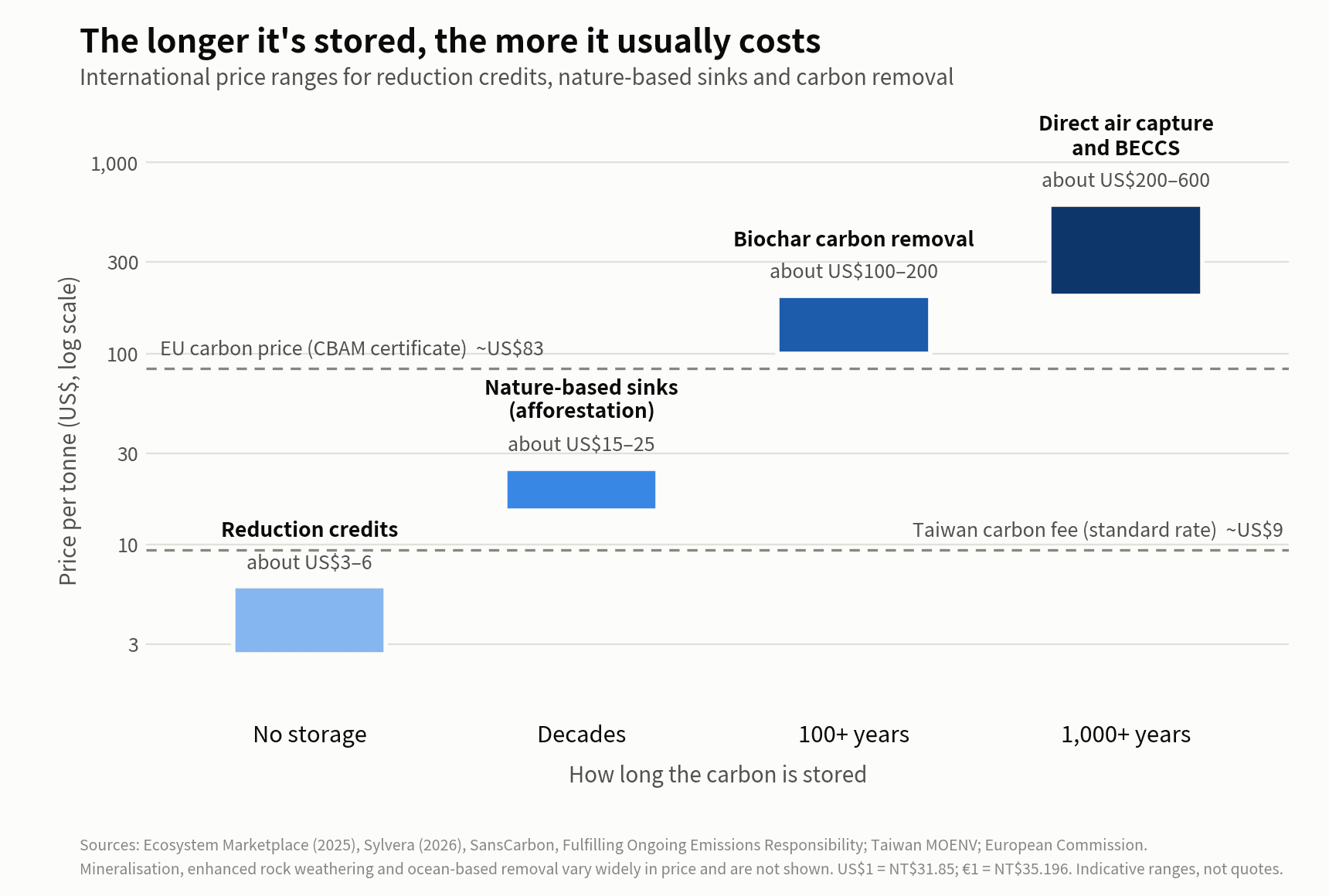
Biochar is one method among several, and currently the most mature and the largest in scale. Others include capturing carbon dioxide directly from the air and storing it underground, and letting rocks or seawater slowly absorb it. These store carbon for longer, but they cost more and are still small in scale.
Net zero means spending as little as possible, and genuinely paying off whatever has been spent. Both are needed, but they have to be kept apart.
| Spending less (cutting emissions) | Paying off the card (carbon removal) | |
|---|---|---|
| What it does | Reduces future emissions | Takes emitted carbon back and stores it |
| Role in net zero | As much as possible | Deals with what cannot be cut |
| Cost | Lower | Higher |
Why a separate ledger?
Imagine recording "money I didn't spend this month" and "debt I actually paid off" in the same book. The book looks healthy, but you can no longer tell how much of the debt has been repaid.
Carbon accounts work the same way, which is why international rules count reductions and removals separately. Carbon removal also has to prove one more thing: that the carbon really has been stored, and for how long. That is also why removal costs more. Paying off debt is harder than spending less.
What does this have to do with Taiwan?
Sooner or later, Taiwanese companies will have to follow international carbon rules. Products such as steel and aluminium sold into the EU face its carbon border adjustment, and multinational customers ask their suppliers to reach net zero with them. International rules will arrive regardless. What Taiwan's own rules decide is who ends up being paid.
The carbon fee is one example. The EU's carbon border adjustment deducts the carbon price actually paid in the country of origin, which is one of the reasons Taiwan introduced its carbon fee. But Taiwan's fee (NT$300 per tonne at the standard rate, about €8.5) is far below the EU carbon price, and the difference still has to be made up when the product enters the EU. The money is not saved; it is simply paid in the EU instead.
Carbon removal may be the next example. International net-zero standards require companies to counterbalance the emissions they cannot cut with carbon removal. If Taiwan issues carbon removal as ordinary reduction credits, international buyers will find it hard to count them as removals, and companies will have to buy abroad. Buying abroad costs more, and much of the good supply has already been contracted by large buyers through around 2030.
So what needs to be done?
Three things, done while the rules are being written:
- Give carbon removal its own name. Issue "removal units", registered separately from reduction credits.
- Grade it by how long the carbon is stored. Storage for centuries and storage for decades differ in both price and use.
- Keep the uses separate. Carbon removal deals with emissions that cannot be cut; what can be cut still has to be cut.
None of these is difficult. The difficulty is timing. In an interview on the international podcast The Carbon Removal Scoop, the minister said that a cross-ministry team would be formed and a national plan drawn up within the next six months to a year. Drawing the line while the rules are first being written is far easier than changing them once they are set.
Frequently asked questions
Does planting trees count as carbon removal?
Yes, but it is not the same as biochar. Think of two kinds of savings. Durable carbon removal such as biochar is like a fixed-term deposit, locked in for a hundred years or more. Tree planting is like an ordinary savings account: fire, pests or logging can "withdraw" the carbon that was stored. Both have value, but their duration, price and uses differ, which is why they need to be graded.
Is biochar the only form of carbon removal?
No. Other methods include capturing carbon dioxide directly from the air and injecting it underground; capturing the carbon dioxide released when biomass is burned for energy and storing it; spreading crushed rock on fields so that it slowly absorbs carbon dioxide; binding carbon dioxide with minerals so that it turns into stone; and absorption through the ocean. Most of these can store carbon for a thousand years or more, longer than biochar, but most are still expensive and small in scale. Taiwan is starting with biochar because it is the most mature method, and Taiwan has plenty of crop and forestry residues to use as feedstock. And because storage times differ so widely between methods, carbon removal needs to be graded by duration.
Can't Taiwan simply use the EU's rules?
Not directly, because the EU's carbon removal certification only covers projects carried out inside the EU. Taiwan has to build its own system, but it can follow the same principles so that the rest of the world can read and recognise it.
What does this mean for my company?
If your company or your customers follow international net-zero standards, durable carbon removal will gradually be required from 2035 onwards. The obligation starts in 2035; preparation starts now.
Read more
| If you want to know | Read |
|---|---|
| How this ledger should be built | Certifying Carbon Removal in Taiwan |
| When companies need to buy carbon removal, and what kind | Fulfilling Ongoing Emissions Responsibility |
| A summary of both reports in English | Research & Publications |
| How to cite | DOIs of the two reports: 10.5281/zenodo.21618472, 10.5281/zenodo.22869799 |
Both reports are written in Traditional Chinese, with English abstracts.
Author: Ming-Cheng Chiu (SansCarbon) | ORCID 0009-0006-8418-0679
Last updated: October 2026
Licence: Creative Commons Attribution 4.0 (CC BY 4.0). You are welcome to republish and quote this page with attribution.